
Louis J. Fox Center for Vision Restoration and VISION Conference

Louis J. Fox Center for Vision Restoration
is hosting the NF-1 update and VISION Conference
November 2 - 4, 2026
The 2026 Louis J. Fox Center for Vision Restoration will host the NF-1 update and VISION Conference from November 2 to 4 in the conference facility of the Vision Institute, located in the UPMC Mercy Pavilion. The NF-1 update will be held on the afternoon of November 2, and it will include presentations on Optic Gliomas and optic nerve damage from respective leaders in the field. The VISION workshop will include presentations on November 3 and 4, from Performers who are working on the Advanced Research Projects Agency for Health (ARPA-H) funded project awarded to Stanford and its subcontractors. The project is under the ARPA-H Transplantation of Human Eye Allografts program led by ARPA-H Program Manager Calvin Roberts, M.D. Team members in all TA groups will give presentations. We anticipate significant progress updates in surgical approaches, donor selection, preservation, axon regeneration, inflammation/immune responses, and development of nerve wrap therapeutic technologies. We aim to identify fundamental aspects of whole eye transplant to define the significant barriers and formulate realistic paths forward to address these challenges. We anticipate approximately 49 speakers, with a format allowing everyone to deliver a research presentation and ample discussion time.
This research was, in part, funded by the Advanced Research Projects Agency for Health (ARPA-H). The views and conclusions contained in this document and all conference presentations are those of the authors and should not be interpreted as representing the official policies, either expressed or implied, of the United States Government.
Meeting Venue: Vision Institute at the UPMC Mercy Pavilion
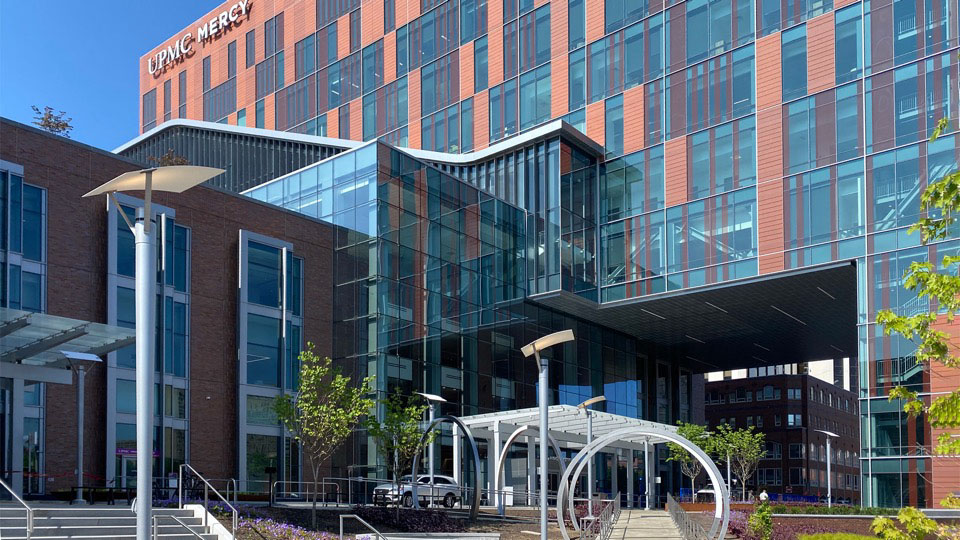
The meeting will be held in the conference facility located in the Mercy Pavilion (pictured above). The 410,000 sqft Pavilion is 80% occupied by the Department of Ophthalmology clinical and research divisions and provides a home for the UPMC Vision Institute. Mercy Pavilion opened in May of 2023, and the research division occupies roughly 70,000 sq ft on floors 5, 7, and 8. In total, Mercy Pavilion provides ~100,000 sq ft of research space.
More about the University of Pittsburgh Department of Ophthalmology:
The Pitt Department of Ophthalmology and Vision Institute includes 110 clinical and research faculty. The research faculty includes 50 well-funded scientists focused on advancing basic and translational research projects involving corneal cell biology and regeneration; glaucoma (imaging, trabecular meshwork stem cell biology and stem cell-based therapeutics, and ocular biomechanics); retinal and RPE development, degeneration and regeneration; visual neuroscience; ocular infectious disease; ocular immunology; the ocular microbiome; and visual/cortical prosthetics, among other areas. In addition to supporting basic research, our goal includes a strong emphasis on assessing outcomes at both the structural and functional levels. We support platforms for high-resolution imaging (novel enface and functional OCTs, Adaptive Optics, Doppler Holography, metabolic imaging, etc.) and naturalistic environments to analyze the impact of vision impairment and restoration in daily activities (correlated with Patient-Reported Outcomes) in real life. Our multidisciplinary team of physicians, scientists, engineers, and allied experts collaborate to deliver cutting-edge therapies, accelerate the translation of research into clinical practice, revolutionize the treatment experience, and enhance the quality of life for patients with visual impairments.