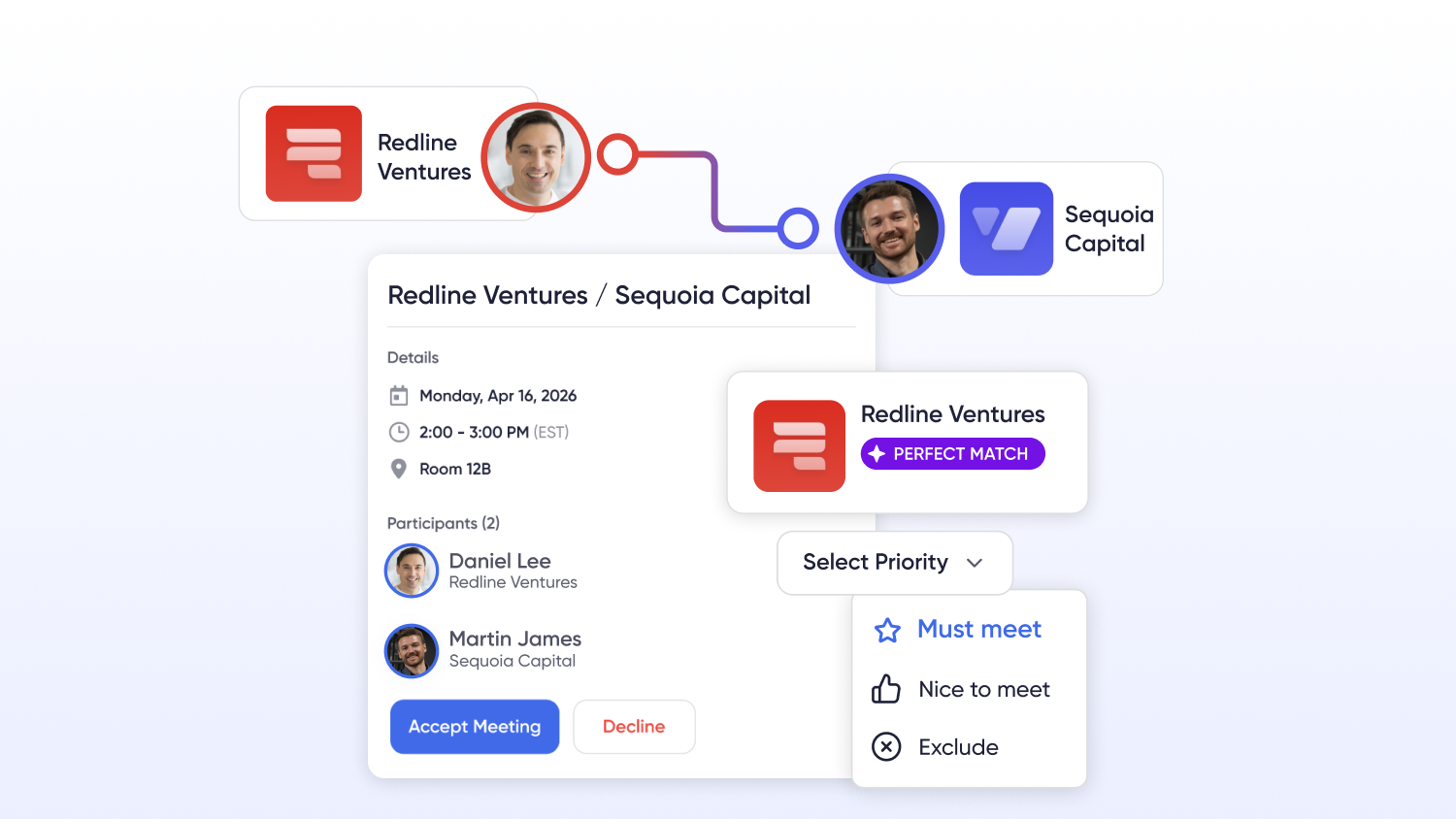
Business today is complicated and often overwhelming, making quickly connecting with the right people vital. Employees are bombarded with too much information, and finding the right partners, buyers, or investors the old way - by chance - is getting less likely and takes too long.
Being able to bypass the clutter and guarantee a meeting with an interested buyer is no longer a luxury; it's necessary to get real value (ROI) from an event. This demand for clear, scheduled meetings is exactly where a Hosted Buyer Program (HBP) comes in.
A hosted buyer program is a matchmaking service inside your event. The organizer hand-picks people or organizations who actually have budget and authority, and often “hosts” them by covering costs like tickets, hotel, or other perks. In some cases, they even pay the buyer to attend. In return, those buyers agree to sit down for a set number of short, one-on-one meetings.

Exhibitors pay to join because instead of standing at a booth hoping the right people walk by, they get a pre-planned schedule of meetings with serious buyers who fit their target. It’s not random traffic; it’s curated conversations.
Behind the scenes, the organizer uses hosted buyer program (like Accelevents) to collect profiles, ask who people do and don’t want to meet, match them up, and generate clean schedules for everyone. The meeting area itself runs like a calm, organized deal room instead of a noisy show floor.
Done well, you’re taking months of scattered prospecting and squeezing it into a day or two of focused conversations, where:
- Exhibitors get better leads and stronger ROI
- Buyers get a VIP, time-efficient way to find the right suppliers
- Organizers get higher satisfaction scores, repeat attendance, and a clear new revenue stream

Defining the Roles: Buyer vs. Seller
In a Hosted Buyer Program (HBP), the terms "Buyer" and "Seller" are used to represent how the two sides are intended to interact, not necessarily a traditional commercial transaction. They represent the two groups whose interests the program aims to align and match.
- A Buyer is the important target person or group who is "hosted."
- A Seller is the person or company that pays for guaranteed, arranged access to the Buyer.
- The interaction is a Sales Talk/Pitch (from Seller) to an Important Person/Group Who Needs the Product (the Buyer).
The fundamental distinction is who holds the primary purchasing intent, authority, or need (the Buyer) and who holds the solution, product, or service (the Seller). Here are some examples:
Notice that in Example 2 above, it would make sense that either type of participant could be the buyer or seller! The Hosted Buyer Program is flexible enough to accommodate many formats.
How to Implement a Hosted Buyer Program
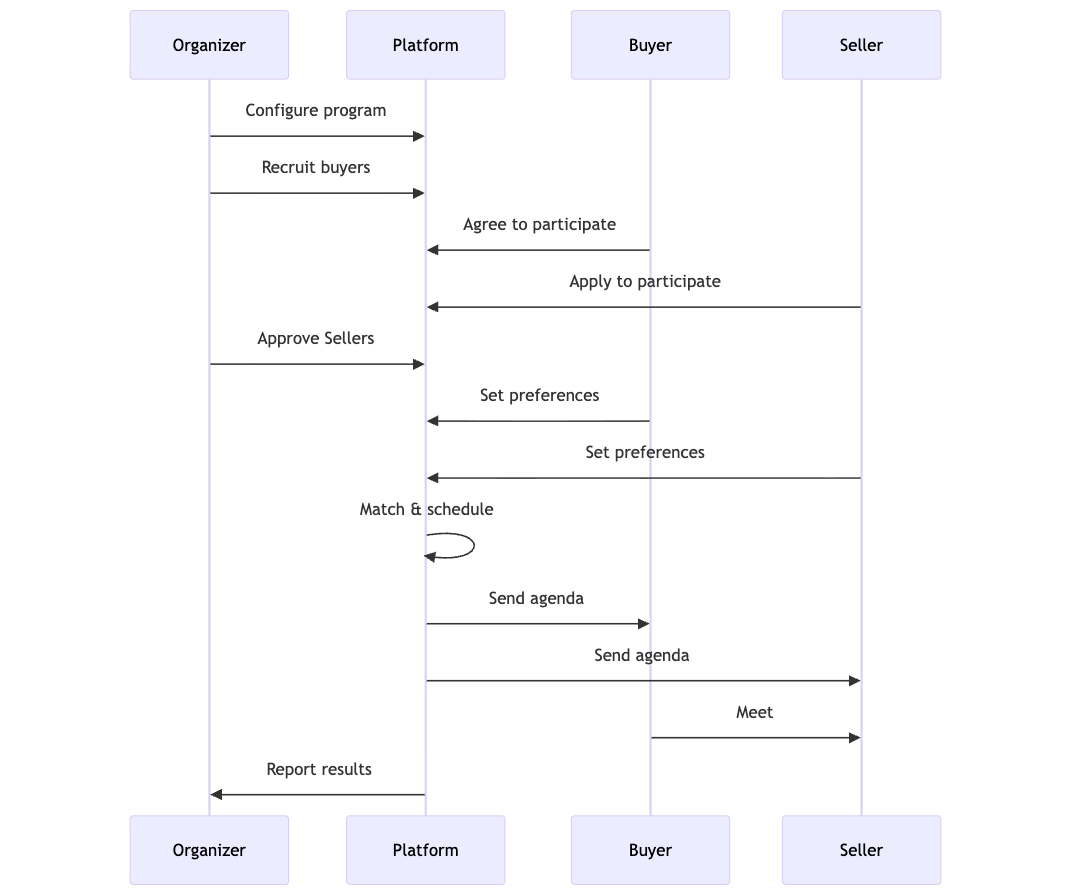
So what does this actually look like in practice? At a basic level, a hosted buyer program is just a structured way to facilitate meetings between groups of people. You make some decisions up front, collect info from buyers and sellers, let software do the heavy lifting on matching and scheduling, and then you host the meetings.
- Plan the program
Decide which buyers you want (real budget and authority), what you’ll give them (free ticket, hotel, VIP lounge, etc.), and what sellers/exhibitors will pay in order to meet them. - Recruit buyers
Invite and approve buyers, making sure they agree to a set number of meetings. - Register Sellers
Get sellers to join your program (for example, using marketing and a registration form), providing detailed information about what they offer and who they want to meet. - Collect Preferences
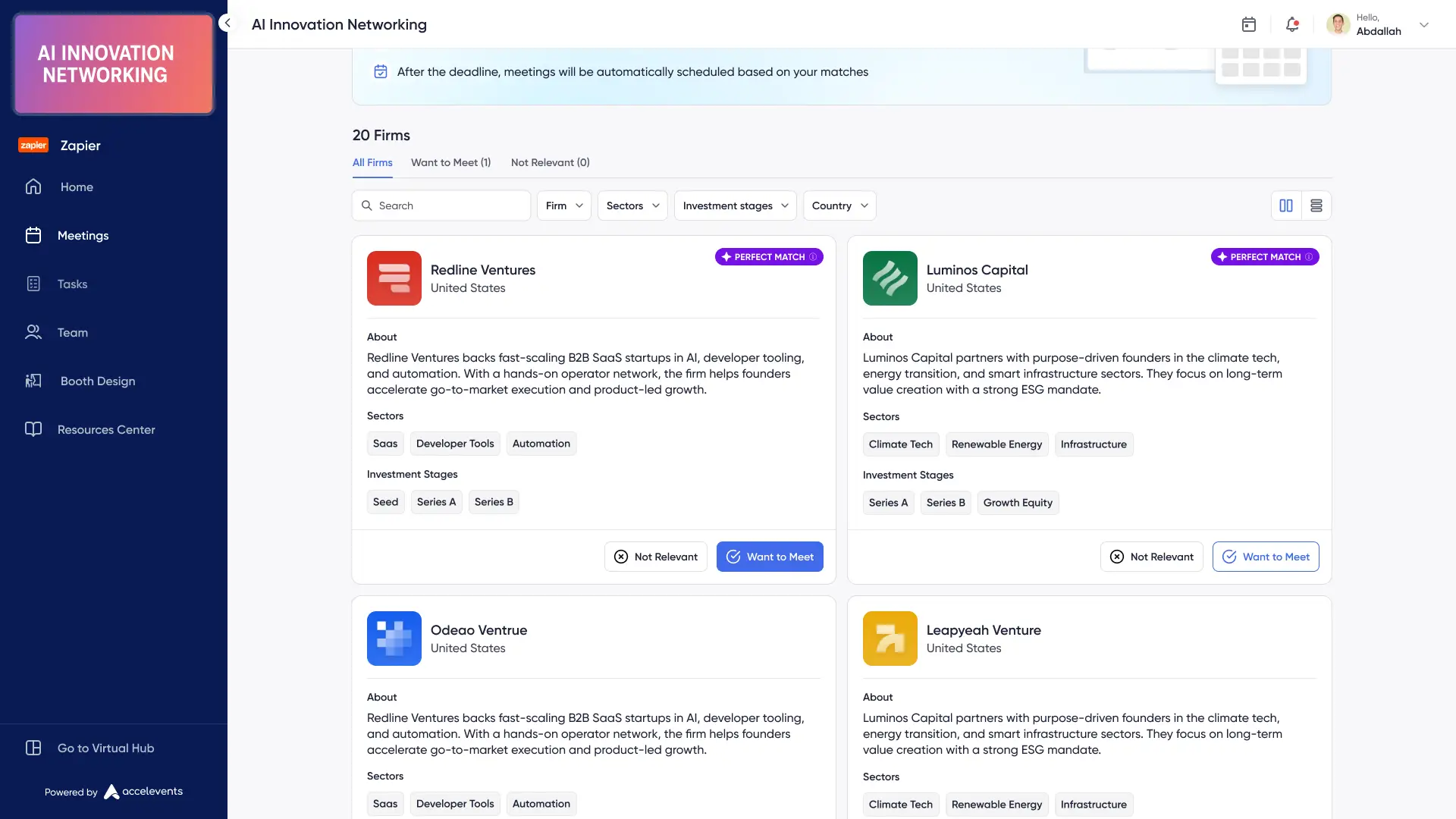
Usually, one or both sides of the HBP will make selections as to who they’d like to meet. Depending on your system you might let them select “Must Meet”, “Nice to Meet”, and “Don’t Want to Meet”. This step in the process lets the system more accurately match people with high-value mutual interests. The right software will make this potentially tedious organizational process much easier. - Schedule the meetings
Once you know who wants to meet whom, you’ll create a slate of meetings that is as fair as possible to every participant, using a set of rules. Then, you’ll send everyone a simple schedule with times and table/room numbers. You can, of course, do this by hand, but the matching and then the communications tasks make it unwieldy even at small scales. Once again, the right software to automate this work makes all the difference.
Run the day and track results
Host the meetings in a quiet, well-marked area, keep things on time, get quick feedback after each meeting, and total up what happened so you can show value and improve next time.
The Right Technology is Key
Using the right tools is an essential element of streamlining a complex operation like a Hosted Buyer Program. A good tech stack will enable you to run your program with fewer people, and scale faster and farther with less investment. It also can ensure stakeholders are meeting with the right people and that sellers are getting the most out of participating in the event so they come back and sponsor in future years.
Essential Components for Your Tech Stack:
- Registration: simple forms, an application process that’s easy to follow, flexible payment options, and a clear and compelling home page.
- Matching: mutual-interest scoring, meeting caps, conflict avoidance logic, and an admin approval and control.
- Onsite: efficient check-in, badge printing, access control, real-time reseating for no-shows, and walk-up registration.
- Mobile App: a single source of truth for meeting agendas, table numbers, note-taking, and push notifications.
The Problem with Fragmented Systems
The hosted buyer segment has been historically underserved because legacy tools focused on either registration or meetings, but rarely both. Organizers have been forced to manually stitch together 2–3 different systems, leading to operational pain, manual data import, bad reporting, and a poor experience for both buyers and sellers. Most hosted buyer tools on the market today only manage the meeting process and:
- Do not handle event registration and qualification.
- Often don’t manage exhibitors fully.
- Are disconnected from lead capture workflows.
How Unified Software Lets You Scale
A hosted buyer platform lets you set up all your rules in one place: who counts as a qualified buyer, how long meetings are, how many per day, what perks you’re offering, and what each exhibitor package includes. It keeps this logic consistent so you’re not juggling spreadsheets and side notes.
- Sign up buyers and sellers
The software handles invitations, application forms, and approvals. Buyers apply online; you review and approve or reject in a dashboard. Exhibitors get their own portal to add company info, products, and goals. Everyone gets clear confirmations and login details automatically. - Set up the meetings
The platform shows buyers and exhibitors each other’s profiles and lets them click yes/no or rank who they want to meet. It then uses that data to auto-match them and build meeting schedules and table assignments, respecting your rules (caps, buffers, no double-booking). You get an admin view to tweak VIPs or fix odd pairings, then push final schedules to everyone’s app or email. - Run the day and track results
During the event, the platform acts as the control center: attendees see their agendas and table numbers on their phones, staff can check people in and track no-shows, and you can move meetings if needed. After each meeting it can prompt quick ratings and notes, then generate reports showing how many meetings happened, how happy people were, and what follow-ups are planned—so you have real proof the program worked.
Software Powers a Successful HBP
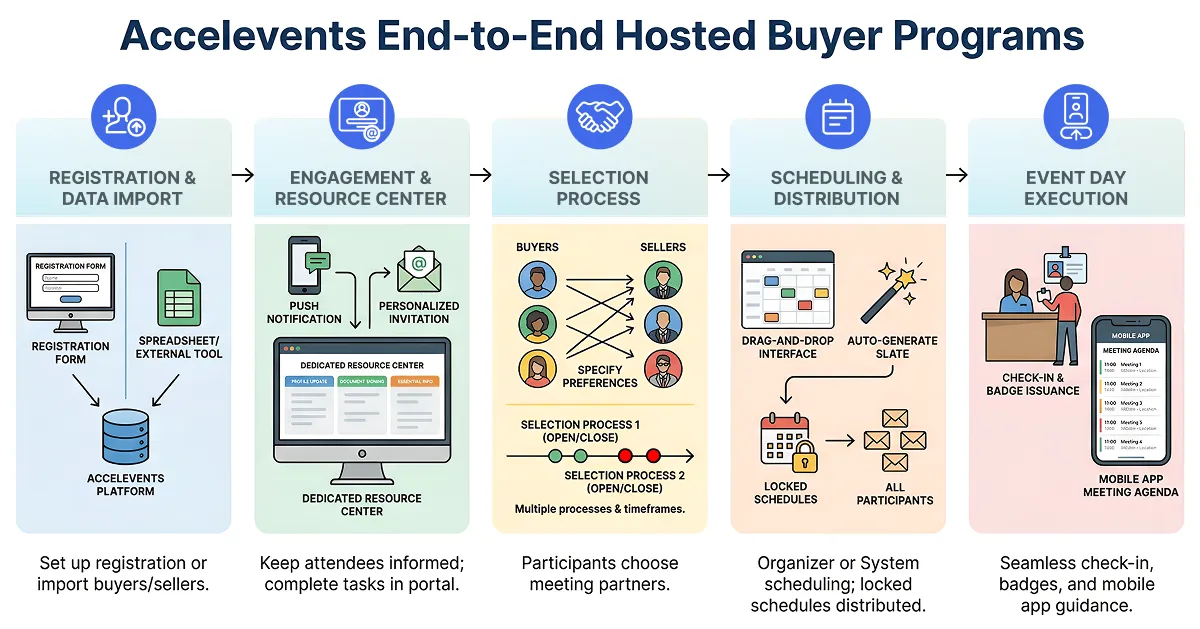
- Accelevents powers hosted buyer programs end-to-end, starting at registration. Event Organizers can set up registration or import buyers and sellers from a spreadsheet or external registration tool.
- The platform keeps attendees informed with personalized invitation emails and push notifications.
- There’s a Resource Center for each participant where they can get important information and address any tasks that you need them to complete, such as completing their profile or signing documents.
- After the registration period has closed, Accelevents guides participants through a selection process where they define who they’d like to meet. Event Organizers can create multiple selection processes that open and close at different times, to make sure that sellers get to select from a list of the buyers most likely to be interested in their product or service.
- Once selections are made, the Event Organizer begins scheduling meetings. This can be done via the built-in drag-and-drop meeting management interface, but Organizers can also have the system automatically create a slate of meetings to approve and edit, cutting down the time and effort required. When the plan is final, the platform automatically distributes locked schedules to all participants to prevent last-minute churn.
- On the day of the event, check-in and badging is handled by the Accelevents system, and participants flow through their meeting agendas guided by the Accelevents mobile app, which keeps track of all meeting schedules and locations.
Hosted buyer program FAQ
How does a hosted buyer program actually work for exhibitors and buyers?
A hosted buyer program is a structured matchmaking track where exhibitors and qualified buyers sit down for short, pre-scheduled meetings. Organizers pre-qualify buyers based on budget and authority, invite sellers that match those needs, then collect meeting preferences from both sides. Hosted buyer program builds fair schedules and table assignments so everyone arrives with a clear agenda instead of hoping the right person walks past a booth.
What should I look for in hosted buyer software integrations and data reporting?
For hosted buyer program, prioritize integrations, unified data, and clear reporting. Look for tools that sync with your customer relationship management (CRM) and marketing systems through a modern application programming interface (API), so buyer and seller data flows automatically into your main database. Platforms like Accelevents connect registration, meeting selection, and onsite check in, then surface performance through real time dashboards and meeting outcome reports. Reviewing best practice guidance on event data integrations will help you avoid siloed hosted buyer data that is hard to analyze later.
How do I choose the right hosted buyer platform for a trade show program?
Start by matching the platform to your team's size, timeline, and internal capacity — not just its feature list. Large enterprise systems can be powerful for global portfolios, but they often require dedicated administrators, certification training, and long rollout cycles before your first program is live. Mid-market platforms like Accelevents bring hosted buyer workflows, exhibitor tools, badge printing, and mobile agendas together in a single connected system, which helps lean teams launch programs faster without a specialist admin team. When you shortlist vendors, schedule demos with two or three, walk through your actual program in each, and confirm the budget, implementation timeline, and support model fit how your team works day to day.
Can hosted buyer programs work for smaller conferences or niche association events?
Yes, hosted buyer programs can work very well for smaller conferences and niche association events. You can reduce the number of hosted buyers, shorten the meeting blocks, and focus invitations on a tight segment of buyers and sponsors so the program still feels curated. Tools like Accelevents let you control caps, rules, and meeting lengths so you can scale down the structure while keeping the same clear, VIP style experience. Many organizers start with a small pilot year, measure meetings held and influenced deals, then expand the model once they see the results.
How do hosted buyer tools support lead capture and follow up for exhibitors?
Good hosted buyer tools give exhibitors built in lead capture that connects directly to their meetings. In Accelevents, exhibitor staff can scan badges from the mobile app, add notes and scores, and see every hosted buyer meeting alongside walk up scans in one set of reports. Connecting this data to your exhibitor management tools makes it much easier to prove return on investment, prioritize follow up, and convince sponsors to renew or upgrade packages next year. For more complex programs you can layer in dedicated hosted buyer software to manage rules, matching logic, and revenue packages in one place.
Conclusion
Hosted Buyer Programs turn events into engineered marketplaces. By making intent explicit, pairing people with precision, and protecting the schedule, you replace serendipity with reliable outcomes - without losing the human element. Keep the inputs tight, the experience calm, and the measurement honest, and your Hosted Buyer Program will raise satisfaction, ROI, and renewal rates across the board.