Most parts of a large event have gotten easier to manage in one place. Event professionals can handle registration, check-in, badges, sessions, speakers, sponsors, and lead capture in a best-in-class event management platform.
Then there is the hotel block.
The frustrating part usually isn’t booking a room. It’s everything that happens around it. Basic questions become hard to answer:
Who qualifies for which rate?
Has the keynote speaker booked yet?
How many rooms have been picked up against the contract?
Did the attendee who registered last week ever reserve a room?
Is the name on the hotel reservation even the same as the name in your registration system?
For most event teams, answering those questions still means jumping between spreadsheets, hotel portals, email threads, and registration data that feels like it lives on a different planet.
I recently spoke with an event organizer managing housing for a retreat of more than 330 people. Every room was being assigned manually. By one person. One room at a time. That seems crazy in 2026!
That’s a criminally negligent technology gap. It deserves its own Netflix special.

Housing is different from most event workflows
Hotel room block management has been harder to bring into the rest of the event experience for a logical reason.
Registration is mostly controlled by the event organizer. They establish the ticket types, pricing, rules, and attendee journey.
Housing introduces another party. The hotel owns the inventory and rate structure. The organizer has a contract with the property, often with minimum commitments and attrition terms. The attendee ultimately reserves a hotel room.
As a result, organizers often manage housing in a system separate from registration. Even when both systems work perfectly well on their own, the event team still has to connect the dots between them.
That’s where the workflow breaks down.
When registration and housing are disconnected
An attendee registers for your event and then gets sent somewhere else to book their hotel.
From the attendee’s perspective, it’s another website, another process, and often another set of information to enter. They may not notice it, but it starts to feel like a lot of work.
From the organizer’s perspective, it creates two records that now have to stay connected. And any organizer is 100% conscious of that.
We've all had issues where the names don’t match. Or someone registers with a work email and books the hotel with a personal one. Or a sponsor uses the wrong rate. A VIP needs to change their arrival date. Someone cancels their registration but forgets to cancel the room separately.
Multiply that across hundreds of attendees, and reconciliation becomes a full-time job.
The event team effectively becomes the integration between systems that were never designed to share the same attendee record.
And, of course, the more properties involved, the harder that gets.
Each hotel may have its own inventory, cutoff dates, reporting format, and process. A multi-property event can quickly become several different room blocks that the organizer is expected to somehow manage as one program.
Manual work isn’t just inconvenient
“Manual work” can sound like an efficiency problem. It’s not that simple.
With hotel room blocks, real money is attached.
Organizers need to understand pickup against contracted inventory, whether rooms are booking at the expected pace, and whether they are approaching an attrition commitment.
Those aren’t numbers you want to discover after someone sends you a report next week. They can change the action you take today.
Maybe registered attendees need a reminder to book. Maybe one property is filling much faster than another. Maybe a particular attendee group isn’t using the inventory you expected.
When housing and registration live separately, getting those answers often means assembling data from systems that were never meant to work together.
And those hotel numbers are competing for attention during the same weeks the event team is finalizing speakers, agendas, sponsors, signage, and the hundreds of other things that have to happen before event day.
Attendees just assume it’s connected
There’s another cost that’s harder to measure: attendee experience.
When something goes wrong, attendees don’t care which vendor owns which part of the experience. All they know is to contact the event team.
If someone can’t find a reservation, needs to change their dates, or isn’t sure whether they booked the right hotel, the organizer is the person they expect to have an answer.
But if the reservation lives in a separate system the event team can’t easily access, even a simple question can turn into a forwarded email and a frustrating wait.
The attendee doesn’t see the game of Twister going on behind the scenes. They see one event. One event organizer. And that’s the experience they should have.
What better hotel room block management looks like
Fixing this isn’t about giving event teams one more dashboard. It’s about connecting housing to the event workflows they already manage.
Here’s what I think event teams should expect.
Registration and reservation data should be connected from the start.
Organizers shouldn’t have to figure out later whether two records belong to the same person. The connection should exist when the reservation is created.
Housing rules should follow the attendee.
A speaker may have access to a different rate than a general attendee. A sponsor may belong in a different property or room block. Those rules should be driven by information the organizer already has rather than checked manually in a spreadsheet.
Pickup and utilization should be visible when organizers need it.
The question isn’t whether you can eventually generate a report. It’s whether you can understand what has been booked against your contracted inventory while there’s still time to act.
The person helping the attendee should be able to see what happened.
When an attendee has a question, the event team should have enough visibility to help them without becoming a go-between for another system.
None of those ideas are unreasonable. That’s kind of the point.
They are basic expectations that become unnecessarily difficult when registration and housing live apart.
This is bigger than room booking
Housing is one example of a broader shift happening in event technology. For years, event teams built their technology stacks one solution at a time.
A registration platform here. A mobile app there. A lead capture tool somewhere else. An abstract system. A housing bureau.
Each choice may have made sense on its own. Collectively, they created a lot of work for the people responsible for making the event feel like one experience.
More logins. More exports. More data to reconcile. More places where an attendee moves from one system into another without knowing or caring why.
The move toward more connected event technology isn’t valuable simply because fewer vendors sounds easier or cheaper (though they are).
It’s valuable because every workflow that can work together is one less connection the event team has to manage manually. Hotel room block management is so impactful because it touches operations, financial risk, and the attendee experience all at once.
Accelevents’ hotel room block management
We set out to address the problem with our new Hotel Room Block Management release.
Our customers asked for a way to connect hotel inventory, bookings, and attendee data in one platform. They wanted to manage housing alongside registration rather than reconciling separate systems after the fact. And we listened.
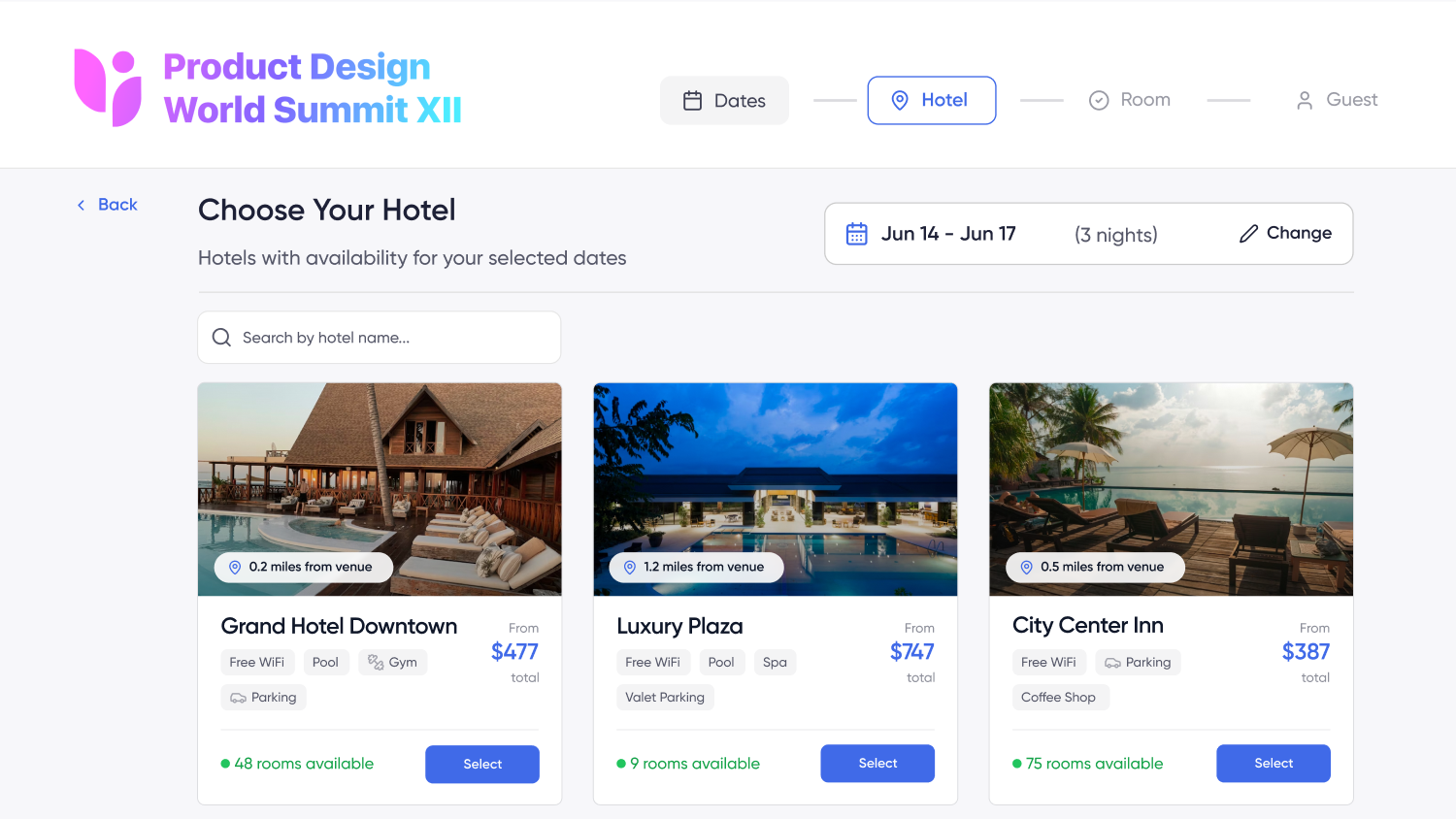
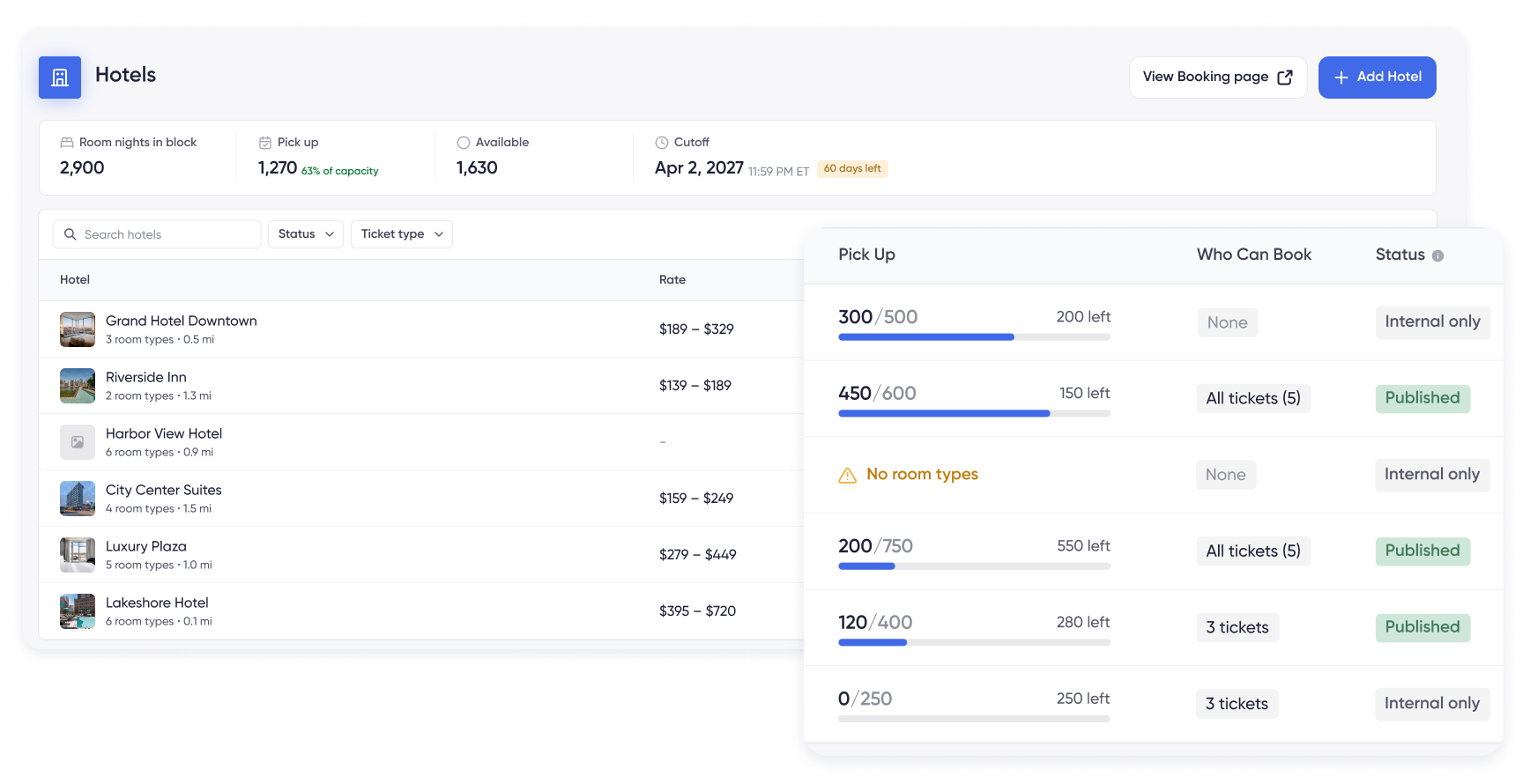
Attendees can reserve a hotel room as part of the registration experience, while organizers can configure properties, room types, rates, and inventory, segment blocks for different attendee groups, and see booking status, block utilization, and attrition in real time.
It’s one more step toward a more connected end-to-end event experience.
Explore Accelevents Room Block Management