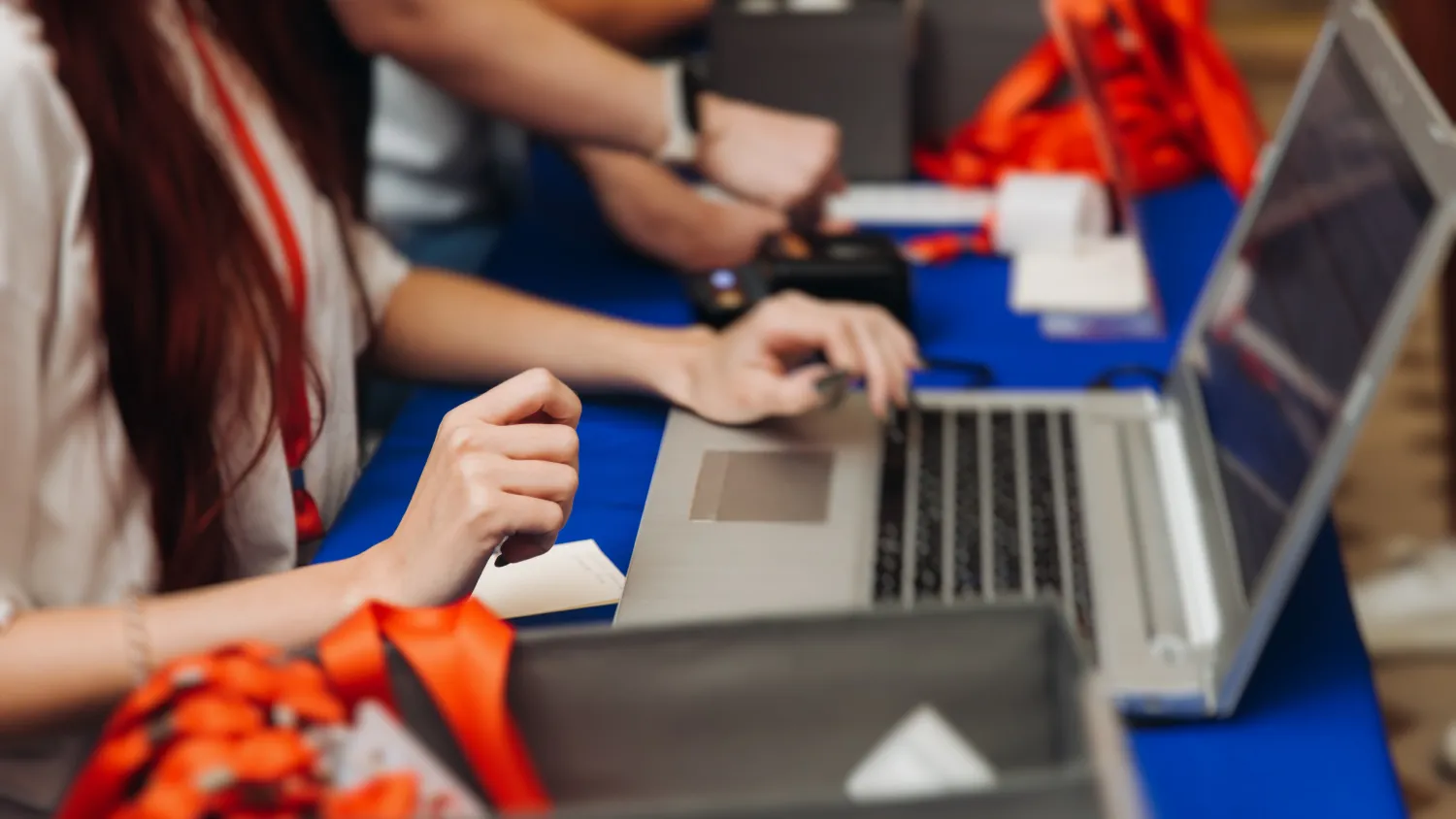
Ten feet by ten feet is not a lot of real estate. Yet at IMEX, Jonathan Kazarian, CEO of Accelevents and Michael Burns, CRO of Accelevents turned that tiny footprint into 126 pre-booked meetings, 116 of which actually showed up. No flashy build, no giant coffee bar, just a tight strategy and a team that treated the show like a true revenue channel, not a three-day logo exercise.
This post breaks down their approach so you can apply it to your own trade shows, then head over to watch the full conversation on the Accelevents YouTube channel.
This interview was originally published on the Event Marketing: Redefined podcast with Matt Kleinrock. Full original episode link here.

What counts as a high performing trade show strategy today?
When we call a trade show strategy “high performing,” we are not just saying the booth looked great or the team came home tired. A modern, high performing approach treats trade shows as a measurable sales and marketing channel where you can trace real pipeline and learning back to specific actions. It covers the entire lifecycle of the show, not just “during show hours.” In practice, you can evaluate a trade show strategy across a few dimensions: clarity of goals and math, strength of pre-show outreach, on-site behavior at the booth, post-show follow through, quality of offers and experiences, and alignment between marketing, sales, and customer teams. Jonathan’s IMEX story is a useful field test of all six.
Inside Accelevents IMEX experiment
Jonathan and Michael did not start with “What should our booth look like.” They started with math.
They knew their average deal size and conversion rates from first meeting to opportunity to close. From there, they backed into a target of 100 meetings needed for the show to deliver the ROI they wanted. In the end they booked 126 meetings and 116 people actually showed, which is a strong show-up rate in a hosted-buyer heavy environment.
They also treated IMEX as a channel with three distinct phases:
- Pre-show: build awareness, support the community, and book meetings.
- During the show: run structured conversations instead of ad hoc demos.
- Post-show: lock in follow-up meetings before anyone leaves Vegas.
Let’s walk those workflows in order.
Pre-show: warming the room before anyone lands in Vegas
1. Start with the goals, not the graphics
Jonathan’s team started with a simple question: “How many meetings do we need for this to pay off?” They worked backward from revenue goals and “normal” conversion rates in their funnel to get to a 100-meeting target. That number dictated everything else: the size of the outreach list, the strength of the offer, and even how many people they brought to staff the booth.
If you are planning your own show, try this sequence:
- Take your average deal size.
- Decide what “success” looks like for that show in booked revenue or qualified pipeline.
- Apply realistic conversion rates from meeting to opportunity to closed won.
- Let that inform how many on-site meetings you actually need.
Only then worry about whether you really need the giant hanging sign.
2. Support the community with something everyone needs
Instead of a generic “Visit us at booth 1234” campaign, the Accelevents team created a simple but powerful asset: a guide to every side event and party happening around IMEX. They published it as a blog post, added a form so other organizers could submit their own activations, and shared it widely on LinkedIn and email. Attendees quickly started passing the link around in DMs and group chats, and it became one of their highest traffic pages in the 30 days before the show.
Because they owned that page, they could:
- Feature their own Topgolf event near the top.
- Highlight a meetup at their booth for agency professionals.
But at its core, the guide was a resource for everyone, not just a sales pitch. That is the key. The more you can function as a source of truth for an event’s “unofficial” experiences, the more your brand feels like part of the community.
If you are designing something similar, you can borrow ideas from your own hosted buyer programs and VIP experiences to decide what belongs in your guide.
3. An offer that feels like a real perk, not a bribe
Their primary pre-show offer was an evening at Topgolf for a tightly defined set of ideal buyers. Because space was limited, they even built a simple approval workflow to keep the guest list aligned with their ICP, rather than just “anyone who wants free drinks.”
This matters because a credible offer improves response to your outreach. “Want to grab coffee and see a demo?” is easy to ignore. “We are hosting 40 heads of events for a relaxed Topgolf night so you can compare notes with peers” is harder to pass up.
4. Omnichannel outreach that feels human
On the outreach side, Michael and the team:
- Pulled a filtered list from the event’s networking portal based on firmographic and demographic criteria.
- Enriched that list with tools like Clay and their own CRM history.
- Sent roughly 3,000 DMs and messages across the portal, email, and LinkedIn, but only to about 20–25 percent of attendees who matched their ideal profile.
Two things made those messages work:
- Executives did the outreach too. Both Jonathan and Michael personally sent messages to high value prospects instead of delegating everything to SDRs.
- The copy led with the Topgolf offer or the side-event guide, not product pitches.
If you are planning your own outreach, this is where a solid exhibitor lead capture playbook can help you define who belongs in that 20–25 percent and how to personalize at scale.
During the show: how a packed 10x10 actually ran
1. No demos at the booth
Counterintuitive but deliberate: Accelevents has a “soft rule” that there are no product demos at the booth. Attendees are bombarded with software screens all day and will not remember which mobile app did what. Instead, the team treats the booth as a discovery zone.
Conversations sound more like:
- “Why are you here this week?”
- “What are you trying to fix in your event program this year?”
- “Where are you spending most of your time when you run events?”
The goal is to understand context, share relevant stories from similar customers, and then book a focused follow-up where a proper demo makes sense.
2. Booth behavior that signals “This is the place to be”
Jonathan and Michael are blunt about it: nobody wants to walk up to a booth where the staff are sitting, facing the back wall, and scrolling their phones. They insist on:
- Standing posture and open body language.
- No rows of people hunched over laptops.
- A sense that the team is actually enjoying themselves.
They also do small practical things that keep energy high, like bulk-ordering Uber Eats to the booth in the morning so nobody has to burn time in food lines at lunch.
The result is a virtuous cycle: when attendees see a booth that is consistently busy, with people laughing and talking instead of watching slides, they naturally drift over. That buzz led to another 20 or so qualified walk-ups who turned into scheduled follow-ups after the show.
3. Managing pre-booked and walk-up conversations
Because they had 126 booked meetings, the team needed to avoid chaos. Before the show, marketing and sales went through the list of every pre-scheduled meeting, reviewed LinkedIn profiles, and made sure they knew who was coming and who would host each conversation.
Onsite they had one person essentially “air traffic controlling” the booth, greeting people as they arrived, routing them to the right colleague, and making sure walk-ups were welcomed into the flow instead of hovering awkwardly on the edge of the carpet.
This does not require complex tools, just prep, coordination, and a clear division of roles.
Post-show: locking in follow-ups while badges are still on
The Accelevents team treated “follow-up meeting scheduled” as one of their key success metrics. Their rule of thumb was simple: if it makes sense to continue the conversation, book the next call while you are still standing in the booth together.
They used a mix of:
- Shared Google Calendars open on phones and laptops.
- QR codes on the back of business cards that linked to individual meeting links.
By the end of IMEX they had more than 40 follow-up meetings scheduled directly on site, with the final total of post-show meetings landing somewhere in the 80s after additional coordination with broader buying teams.
The takeaway: every minute you wait after the show to “start following up” is a minute where attention fades and the inbox fills up. If you can, treat follow-up scheduling as the last step in your on-site conversation, not a separate phase that starts next week.
For more ideas on turning those meetings into pipeline, this piece on how event marketing can optimize B2B sales is a helpful companion read.
What CEOs and event leaders can steal from Accelevents playbook
You do not need the same product or team size to apply these ideas. A few principles travel well.
1. Treat trade shows like a math problem, not a hope-based exercise.
Set a meetings target based on realistic conversions and work backward. Do this before you sign the contract, not after.
2. Give the community something genuinely useful.
A simple side-event guide, a hosted buyer concierge, or a curated set of meetups can do more for awareness than another generic booth teaser.
3. Get executives in the outreach.
When CROs and CEOs send authentic, relevant messages, people notice. Saying “Our CRO will be at the booth” is not the same as having them actually send the DM.
4. Ban pitch-first conversations.
Use your booth to listen first, then advise, then schedule a proper product conversation for later. That single shift can transform how attendees experience your brand.
5. Design for energy, not just aesthetics.
How you feed, rest, and support your team will quietly show up in your numbers. A tired booth full of checked-out staff will not hit its meetings target, no matter how pretty the backdrop is.
Demo / POC checklist: pressure-testing your next trade show plan
Even though Accelevents story is about exhibiting, the mindset is similar to running a proof of concept. Before your next major show, you can treat your plan like a mini POC and stress test it using a simple checklist.
Pre-show planning
- Write down your revenue target and back into a meetings goal with real conversion rates.
- Define your ICP for this show and confirm how you will build and enrich that list.
- Decide on a clear “give to get” offer that aligns with your audience, not just a generic raffle.
Community and content
- Choose one community resource you will own, such as an unofficial side-event guide or a hosted buyer survival guide.
- Map how you will distribute it in the 30 days before the show across email, social, and event tools.
Onsite workflow
- Assign one person as booth “air traffic control” to manage arrivals and routing.
- Train your team on a simple discovery script focused on goals, tactics, and gaps instead of feature tours.
- Decide ahead of time how you will schedule follow-ups and make sure everyone has the right links handy.
Post-show proof points
- Track not only total leads but also meetings held, follow-up meetings booked, and opportunities created.
- Review which offers and outreach messages generated the best meetings, not just the most responses.
If you already use an event platform, you can use this checklist alongside more formal hosted buyer software evaluations to make sure your tech actually supports the workflows you just designed.
Putting it together
Accelevents IMEX story looks impressive on the surface, but it is not magic. It is a series of deliberate choices that any event team can borrow: treat the show like a measurable channel, give the community something useful, have leaders join the outreach, run the booth as a place for real conversations, and book follow-ups before people step on the plane home.
If you watch the full interview on the Accelevents YouTube channel with your team, try pausing after each section to ask, “Where are we already doing something similar, and where are we still improvising?” That gap is your roadmap for the next big show.
FAQs
How early should exhibitors start pre-show outreach for a major trade show?
Most exhibitors see the best results when they start focused outreach four to six weeks before the event. That gives you time to build awareness, share useful content, and secure meetings before attendees’ calendars fill up. If the event app opens later, you can still warm the right accounts with email and LinkedIn before you start sending in-portal messages.
What is a realistic meetings goal for a 10x10 booth at a flagship event?
A realistic meetings goal depends on your team size, show length, and deal cycle, but Jonathan’s team targeted 100 meetings for a 10x10 at IMEX and ended up with 126 booked. Work backward from your revenue goals and average conversion rates instead of copying that number directly. The important part is that your goal is grounded in math and that your pre-show plan actually supports reaching it.
How can small event teams create community value like Accelevents IMEX guide?
Small teams can start with a simple curated list of side events, meetups, and useful local tips rather than a huge production. Collect information from partners, sponsors, and fellow exhibitors, then publish it as a shareable page or PDF. The key is to keep it vendor-neutral and genuinely helpful so attendees naturally forward it to colleagues and friends before the show.
How do you keep booth staff energized without burning them out during long show days?
You can do a lot with small practical steps like pre-ordering food to the booth, rotating quick breaks during natural lulls, and being explicit about posture and presence expectations. The Accelevents team even ordered Uber Eats to the booth so staff did not waste time in lines, which helped them stay present and engaged through heavy traffic. Taking care of basic needs makes it much easier for everyone to bring real energy to attendee conversations.
What is the best way to secure post-show follow-up meetings while still on site?
The simplest approach is to pull up a calendar during the booth conversation and offer a specific time window instead of saying “We will follow up later.” Some teams also print QR codes on business cards or signage that link directly to scheduling pages. The Accelevents team booked dozens of follow-ups this way at IMEX, which meant they left the show with a clear, committed pipeline of next conversations.